It’s time for Tu B’ShevatA Rare Opportunity to Plant Fruit Trees in Israel
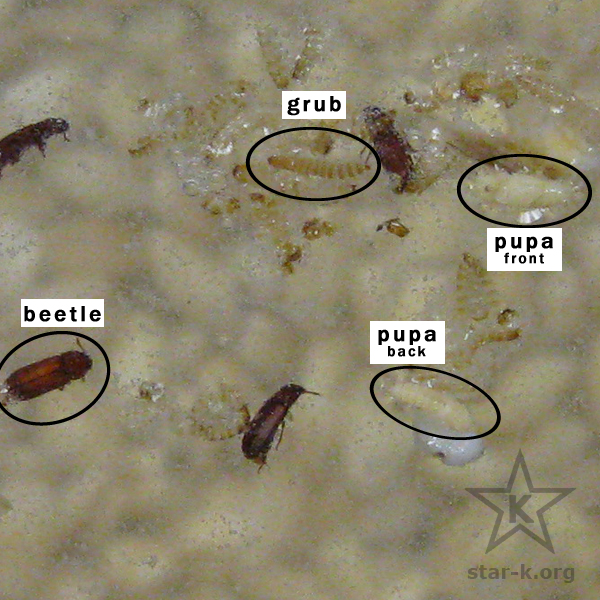 Closeup of floating insects when barley is submerged. Tu B’Shvat, the Jewish New Year for trees, is this coming Thursday, January 16, 2014. From: Rav Lazer Brody Why in the world does Judaism require a New Year for trees? Here’s a better question: The nations of the world, in protesting our right to the Land of Israel, claim that all the other religions are fine with living in a variety of countries, so why must the Jews have their own land? Many Jews don’t know the answer to this seemingly-probing question. Yet, the answer is surprisingly simple. It also explains why we have a special New Year for trees, when it’s a special mitzva to plant trees all over the Land of Israel. From:Ask OU Kosher A: Yes. Different varieties of certain fresh or frozen vegetables could potentially contain insects, which are considered not kosher and prohibited. Vegetables that have this concern must be checked before they are prepared or consumed, to ensure that there aren’t any insects hiding in cracks, crevices, or grooves of the vegetable. Moreover, canned vegetables could potentially be cooked in equipment that also processes genuinely non-kosher products, such as pork and beans. Vegetables that are from Israel are also subject to additional requirements of mitzvos hateluyos be’aretz. Below are links to PFD files from the various rabbonim and institutions with their instructions as to what fruits require inspection and how this is done 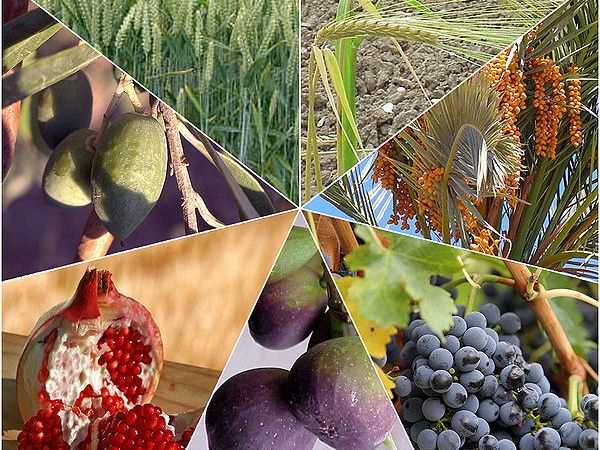 Tu-b’Shevat Seven Species |
|
Rav Elchanan Elgrod: Breslov Posek-The laws and customs of Tu B’Shevat-24January2013 |
|
 R Vaye Tu B’Shevat 5774 Page 1 |
|
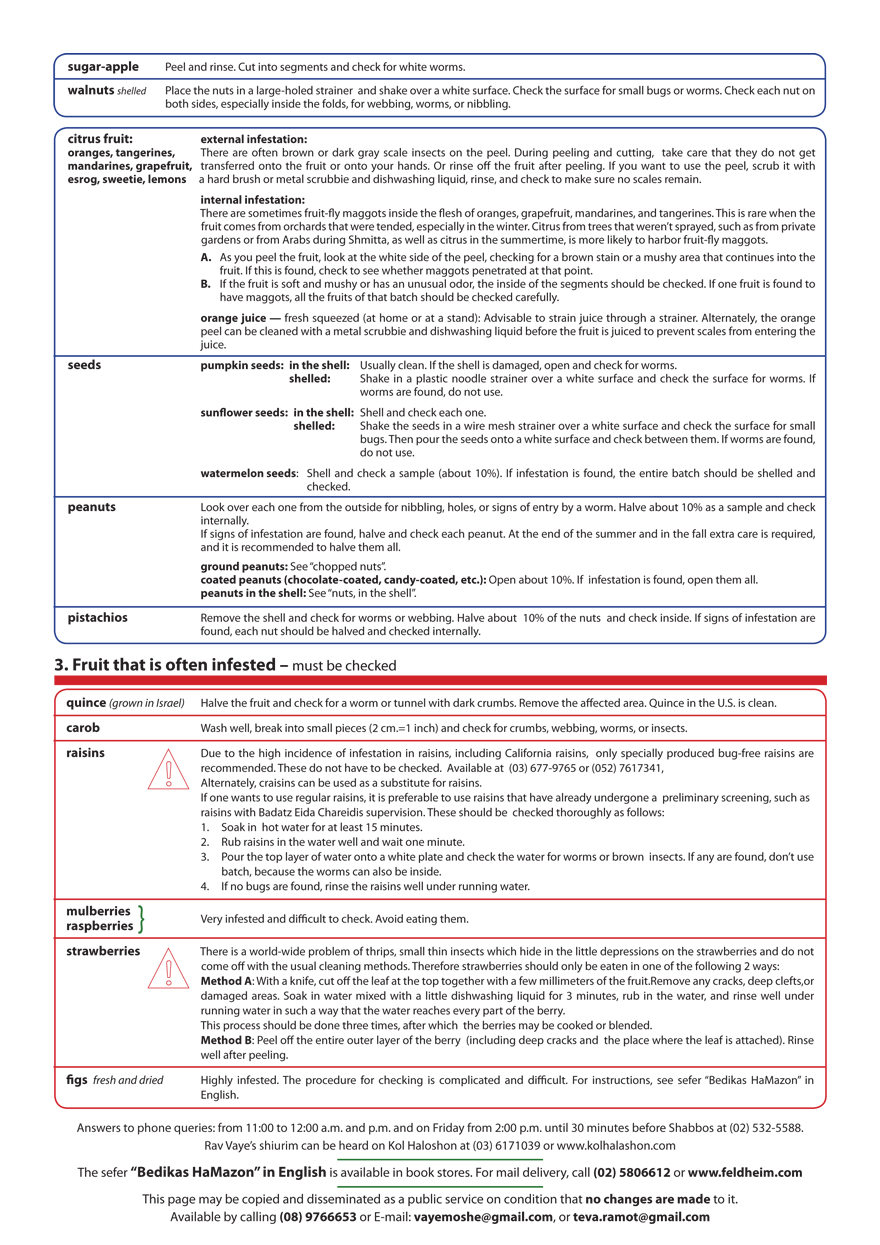 R Vaye Tu B’Shevat 5774 Page 2 |
|
Click here for larger image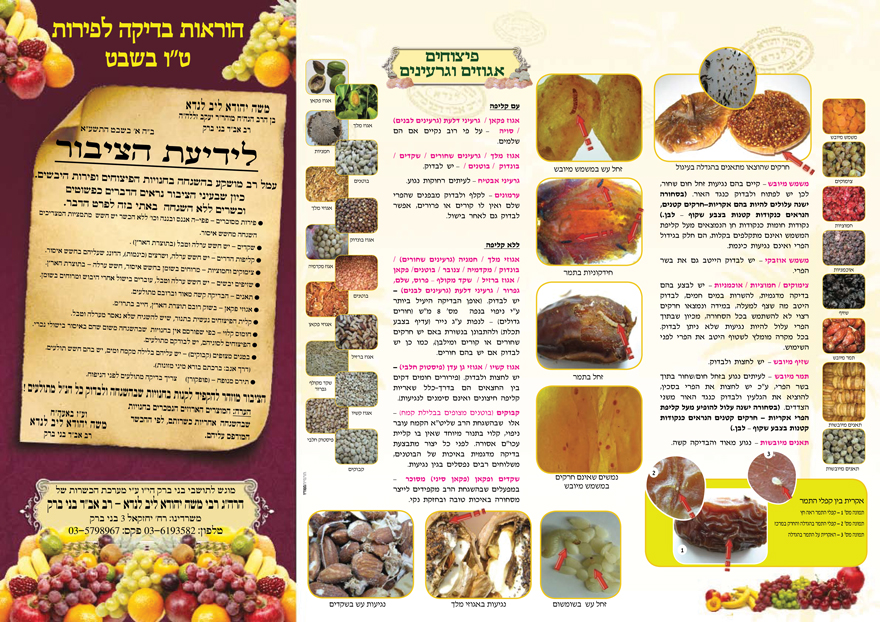 R Landau 15 Shevat 5774-Page 1 |
|
Click here for larger image
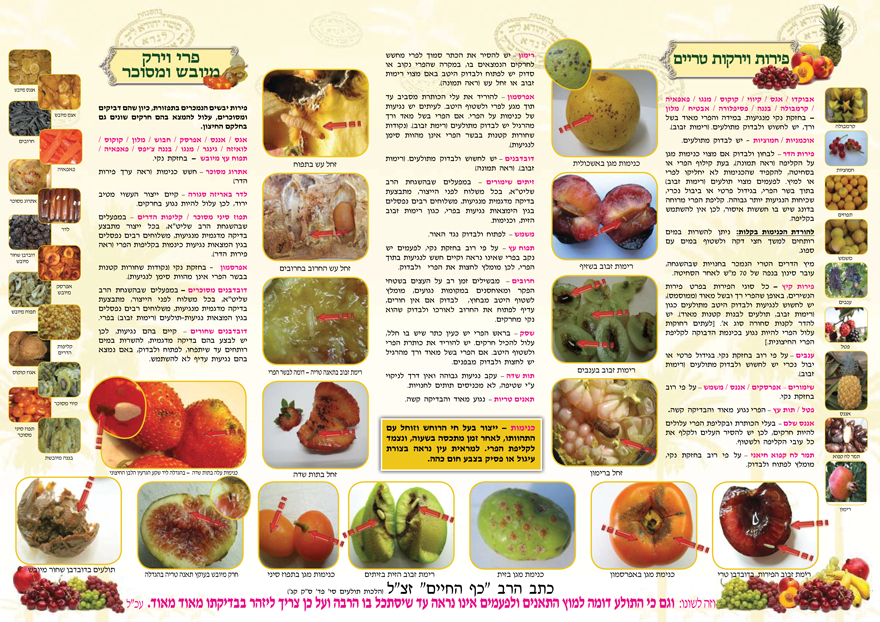 R Landau 15 Shevat 5774-Page 2
|
|

Tu B’ShvatTu B’Shvat is the New Year for trees, yet one of the customs is to have a seder! Which is it – Rosh Hashanah or Pesach? Read some of the beautiful customs of this unique holiday…Rabbi Shalom Arush | Posted on 12February2025
Every Rosh Hashanah has its own aspect. Tu B’Shvat is the New Year for the trees, and judging the trees. A tree makes mistakes that it needs to be judged? Every tree is a human being. People own the trees, so depending on the merit of the people, it depends on whether or not the trees will produce a lot of produce for the people who own them. Therefore, we pray on Tu B’Shvat that the trees should produce good fruit. Everything depends on the people and their merit. So we ask for Hashem to bless all the trees that they should grow a lot of fruit.
Like the tree that is written about in the Gemara, that is written on it, “Tree, tree! How am I going to bless you? Your fruit is sweet, your shade is wonderful, and water runs close to your roots…”
There is a segula to hang the names of people who are looking for their soulmate on the branches of fruit trees. Hashem blesses the trees, so Hashem also blesses the people whose names are hung on that tree. Really, it is a segula for everything, healing, etc. – not only for shidduchim.
A man is a tree of the field. We want to be wonderful trees with sweet fruit. We also want our children to be like wonderful, sweet fruit that falls from the tree. Just like a tree needs to be watered, so too, a man needs to be watered. What is water? The Torah, and prayer. The main thing is the water!
The Tu B’Shvat SederThere is a custom to pray for the coming year’s etrog crop, as well as your personal etrog to use on Sukkot as part of the four species. Breslev custom is to pray for the etrog from Likutei Tefillot by Rabbi Natan of Breslev – the sections of prayers 33 and 57 that deal with the etrog.
Many, including the posek and dayan of Chut shel Chessed, Rabbi Elchanan Elgrod shlita, also have the custom to recite the special prayer of the Ben Ish Chai for Tu B’Shevat.
This is aside from the Tu B’Shevat Seder itself, of which there are a number of customs.
The Ashkenazi custom is to eat 15 specific fruits (the custom of Rabbi Elgrod): wheat bread (this begins the seder with washing for bread), wine or grape juice, olives, dates, figs*, pomegranate, etrog, apple, walnuts, carob, pear, cherries, almonds, peaches, and peanuts.
Some recite the 15 “Shir HaMaalot” chapters of Psalms 120-134.
There is also the Kabbalistic custom of the Seder as outlined in the Pri Etz Hadar. Three plates are arranged:
There is also a custom to have a new fruit on Tu B’Shvat which has not been eaten yet that season, in order to recite the “Shehecheyanu” prayer on it. Others are careful to eat of the “Seven Species” for which Eretz Yisrael is specifically praised: wheat, barley, figs*, dates, grapes, olives and pomegranates.
*Unfortunately, in our days all figs are infested with worms and finding all of them is virtually impossible. Therefore, it is not recommended to eat figs. You can have a container of figs on the table to look at, which is perfectly acceptable. The posek Dayan Rabbi Elgrod shlita carefully cuts out a tiny section of skin with a sharp knife, soaks it in soap for 3 minutes, then rinses and checks it carefully against the light. It is easy to check since there is no fruit whatsoever included, and it is see-through. This he brings to the table and eats a tiny piece of, in order to eat fig on Tu B’shevat.
|
|
The Tu B’Shvat SederMany people traditionally celebrate Tu B’Shvat – the New Year for trees – with the lovely custom of having a “Seder” where they rejoice in the exquisite fruit of the trees.Breslev Israel staff | Posted on 09January2009 | Web Archive https://web.archive.org/web/20220118220527/https://breslev.com/319560/
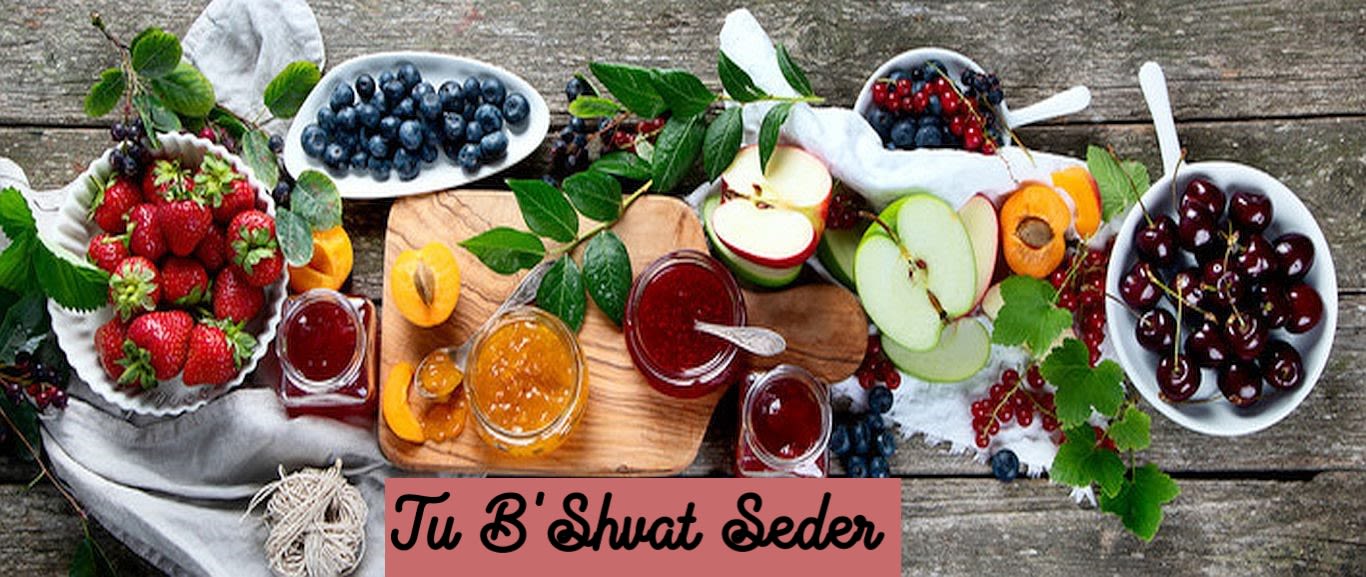 Tu B’Shvat Seder
Tu B’Shvat is the traditional Rosh Hashanah for trees. There are four Rosh Hashanahs or New Years mentioned in Jewish tradition; and each occurs at a different time of year.
Man is compared to the trees – the divine logic can be observed from Scripture. “Man is as a tree of the field”. (Deut. 20,19) On Tu B’Shvat, the primary goal, as discussed in the traditional sources, is to rectify the original sin that occurred through Adam the First. It is mentioned in Jewish literature throughout the ages, that Adam’s sin was not in partaking of the fruit of the tree revealing good and evil, but that he did so prematurely – before his prayer to do so had been accepted from on high.
During Shvat trees begin to grow exceptionally well. Most of the rains have fallen, but growth has still mostly not yet occurred. Certainly, the full moon on this mid day of the month – the Jewish months are essentially lunar, is also quite relevant. Shvat is considered to correspond with the ‘dlei’ – the water bearer, known also as the astrological sign of Aquarius – which corresponds to the tribe of Asher, who was especially blessed through the olive and other trees.
Several different arrangements to the Tu B’Shvat seder have evolved. The arrangement following the customs of the ‘Pri Eitz Hadar’ were originally popular, but various Askenazic and Sefardic communities have arrangements which vary from this to a large degree. There is also a Jerusalem custom for the seder as well. The Pri Eitz Hadar is commonly attributed to Nosan of Gaza; the main leader of the false messianic movement of Shabbtai Tzvi of the sixteenth century; and thus, many refrain from following that arrangement.
The traditional seder arises in this manner. There are selections from Tanach relating to fruits and trees. Also, there are selections from the holy Zohar that relate to fruit, to the trees, and to blessing. The introductory selections also include a simple and timely prayer. Subsequent is a seder; centering on eighteen varieties of fruit. The seder, however, is preceded by eating cakes and cookies of wheat. Then, fruits of the nut type are usually eaten first. If making the seder with wine, these are followed by a cup of white wine. Fruits edible only on the outside are eaten next. Afterward, is a cup of mostly white wine, but with some red. Then fruits which are totally edible. These are followed by a cup of wine mostly red, but with a substantial amount of white. After this, the seder calls for other fruits to be eaten (of any type), and these are followed by a cup of red wine, but having just a minute amount of white. At the conclusion, lupines are eaten, (or other fruits or nuts of the earth; i.e. peanuts).
This is another customary arrangement. The man – after Birchos HaMazon (the Grace following a regular meal which includes bread) makes the blessing over ‘mezonos’ grains (and of course, afterward eats) this additional item (cake or cookies, etc.) of wheat; and repeats the verse: “You shall be satisfied through the fat of wheat”. One does this as an omen and in hope of obtaining a blessing of plentiful sustenance throughout the year. The woman recites a blessing over wine or grape juice; saying: “Your wife shall be bear forth as the vine”. The son says the blessing over olives, and the verse: “Your sons shall be as shoots of the olive tree, surrounding your table”. Pomegranates and walnuts are eaten first by one’s daughters, and they say the following: “The glory of the king’s daughter lies within”. (The outsides of these fruits are all inedible – thus, lying within). Date honey and apples are given to the infants, as paralleling the teaching: “I raised you from under the apple tree. Honey and milk were under your tongue”. It is also customary to recite chapters of the mishnah over each fruit.
In kabbalistic teachings, four mystical realms are said to exist. Ten varieties of fruits exist in relation to each of the three lower realms (the highest is too austere for reflection in materiality). The highest of these fruit types are (theoretically) completely edible. These are closest of all to the highest realm of Pure Emanation – being of the realm of Conception or Creation. There are likewise 10 species of fruit in correspondence to the next lower realm of Formation. These are not as close to impurity as those related with the lowest world of Action, but not as far off as those emanating from the higher world of Creation. Therefore, the seeds existing within the fruits of this second category remain inedible. There are additionally ten varieties of fruits of the realm of Action or Physicality – paralleling its traits. In this group, the section of the fruit within is edible, while that which is on the outside is not. The shell of these fruits separates between the nut and between the state of ‘overall confusion’ existing on the outside beyond.
There is also a fourth category of tree that bear fruit that is mostly or totally inedible or not at all. It is mentioned that Rabbi Chaim Vital for one, distanced himself from these, he being a master of the soul. For these all have relation to ‘the side of the left’. One can’t help but notice the sages’ astute recognition long ago, of the potential ill effects of plants and compounds derived from trees such as these, which are so often misused today: cocaine, marijuana, and others, – as these also, are derived from trees and plants corresponding to this last non fruit-bearing category.
The four types of wine (white, red, and their mixtures) reflect the four seasons of the year. White is indicative of autumn. White with some red represents the winter – (the red ‘warmth’ of spring even then somewhat perceivable). Red with some white, as traditionally used for the third cup, is the spring. Pure red is the summertime, when the crops have fully matured. The fifteen traditional fruits of Tu B’Shvat are the following. Of Creation: figs, grapes, apples, pears, and quince. Of Formation: dates, olives, plums, cherries, and hawthorn berries. Of Action: pomegranates, almonds, walnuts, lupines (these are fruits of the earth, and not of perennial trees), and ‘sidrah’ (a tree nut).
Rabbi Chayyim Vital, disciple of the holy Arizal, mentions that there are ten species of each general variety of fruit; thus thirty primary species, and each is indigenous to Israel. Each species also has many varieties. This follows the sages’ interpretation of the verse: “…and seventy dates”. They understood this to imply there were seventy varieties of dates. So, then is the case regarding other species of fruit. These thirty species therefore have among them several varieties of the same fruit. Also, each is primarily attributed with a particular of the ten ‘s’firos’ or divine attributes as generally known from kabbalistic and chassidic teachings. These ten traits are first the intellectual qualities of keser (the crown); chochmah (wisdom) and binah (understanding). Then follow chesed (kindness); g’verah (restriction or holy selfishness) and tiferes (beauty – especially as a balancing of these previous two traits).
Then netzach (the enduring quality of truth), and hod (glory of truth). Then yesod (the foundation of purity – especially as an extension of personal lifestyle. Finally, there is malchus (the sovereignty of G-d, and spontaneous service of Him). These parallel the ten sayings of G-d during Creation; within the Ten Commandments, as well as many other facets of reality and of Torah thought.
The thirty are the following. Of Creation: grapes, figs, apples, esrogim (citron), sweet lemon, pears, quice, mulberries, sorb-apple, and carob. (Questions regarding the apparent inedibility of the pits of some of these is discussed). Of Formation: olives, dates, sweet cherries, jujube, peaches, plums, apricots, sour cherries, hawthorn berries, loquat. Of Action: pomegranate, walnuts, almonds, chestnuts, hazelnuts, oak nuts, coconut, pignolias or pine nuts, pistashios, and Israeli pistachios.
Interesting, also, is that the Tu B’Shvat seder is very similar to the Passover seder exactly two or three (Hebrew) months away. It may be understood, that just as the primary citing of the Passover seder, is ‘to teach one’s sons on that day’, here the purpose is to teach oneself – of the inner meaning and relevance, of the Torah’s traditions.
Many have the tradition of saying various Scriptural and Midrashic passages before the fruit seder. The passages from Tanach (Scriptures) are not usually said when making the seder at nighttime, however. Many communities also have the tradition to sing afterward.
Any formal observance of a Tu B’Shvat seder or even of eating any fruit whatsoever is of course only customary. Yet, an interesting quote from the past is that of Rabbi Eliyahu HaCohain of Izamir. He mentioned in a testament to his son; “My son, be steadfast to make the blessing over fruit on Tu B’Shvat – for it is a worthy custom and correct, though there is no definitive arrangement to the seder, and no specific tradition to the occasion. Rather, the celebration is according to the situation in which one finds himself, concerning not only which fruits one eats, but also, in which order.
(Courtesy of www.TorahTorah.com, ©Copyright by Mazel Project, Monsey, New York 5752/’91)
|
|
 Kabbalistic Tu B’shvat Seder Kabbalistic Tu B’shvat SederOn Tu B’Shvat, you can ponder a world-full of fruits for hours.by Yitzhak Buxbaum http://www.aish.com/h/15sh/ho/48965616.html (1) INTRODUCTION Tu B’Shvat is the New Year for the Trees. As in all other points in the Jewish calendar, Tu B’Shvat offers a unique opportunity for insight into living and personal growth. Throughout the centuries, Kabbalists have used the tree as a metaphor to understand God’s relationship to the spiritual and physical worlds. Moshe Chaim Luzzatto, in his 18th century classic The Way of God, teaches that the higher spiritual realms are roots that ultimately manifest their influence through branches and leaves in the lower realms. In the 16th century, the Kabbalists of Tzfat compiled a Tu B’Shvat seder, somewhat similar to the seder for Passover. It involves enjoying the fruits of the tree, particularly those native to the Land of Israel, and discusses philosophical and Kabbalistic concepts associated with the day. Among other things, the seder is a great way to appreciate the bounty that we so often take for granted, and to develop a good and generous eye for the world around us. The seder presented here is based primarily on the Kabbalistic work, Chemdat Yamim, later published separately under the title Pri Aitz Hadar. PREPARATIONS To enjoy this experience in your own home, try to prepare the basic items mentioned below. Don’t worry if you can’t find all these items; do the best you can. Since the order and the contents of the seder do not follow a specific Jewish law, there is much room for flexibility and creativity. You will need lots of fruit, including:
Important note: Since insects are not kosher, check your fruits to make sure they are bug-free. Bugs are especially common in figs, dates, and dried apricots. To check, split the fruit in half and look carefully before eating. (2) THE SEDER BEGINS The leader asks: Why do we celebrate the New Year for fruit trees on Tu B’Shvat? All say: Since the Holy Temple was destroyed, the Jewish people could no longer bring the First Fruits (Bikkurim) to Jerusalem. On Tu B’Shvat we offer instead the fruit of our lips, to praise God for all the fruit trees in the world. A participant says: Tu Bishvat marks a new period for taking tithes, a portion of which is given to the poor. Therefore: When a person is privileged to eat in the presence of God, he must show his appreciation by giving charity to the poor and feeding them, just as God in His bounty feeds him. ( Zohar – Parshat Trumah) At this point it is appropriate to pass around a ‘pushka’ to collect tzedakah. After the seder, the money should be donated to a worthy cause. A participant says: The Mishnah in Tractate Rosh Hashana says that Tu B’Shvat is New Year for the TREE (singular). This reference to a singular tree alludes to The Tree — the Tree of Knowledge in the Garden of Eden. And God said: ‘Let the earth put forth grass, herb-yielding seeds, and fruit trees bearing fruit of its kind.’ ‘Fruit tree’ means the Tree of Knowledge of Good and Evil, which put forth blossoms and fruit. ‘Bearing fruit’ is the tzaddik, the basis of the world. ‘Of its kind’ means all the human beings who have in them the spirit of holiness, which is the blossom of that tree. This is the covenant of holiness, the covenant of peace — and the faithful enter into that kind and do not depart from it. The Tzaddik generates, and the tree conceives and brings forth fruit of its kind. ( Zohar – Bereishit 33a) Meditation: One should intend that he is eating at the celestial table before God, in the Garden of Eden before the Divine Presence. ( Raishit Chochma — Shar HaKedusha) Take a few moments and think deeply about being in the company of God… sitting at His table… experiencing the sublime spiritual pleasure of a relationship with the Creator Himself. Discussion questions: A) When Adam and Eve were in the Garden of Eden, they were permitted to eat only fruits and vegetables. Only after Noah’s Flood did God permit meat. In what ways is it considered spiritually higher to eat meat? And in what ways is it considered spiritually higher to be a vegetarian? B) There were two trees in the center of the Garden: the Tree of Life (representing Torah and eternal life) and the Tree of Knowledge of Good and Evil (representing death and distortion). Another way of expressing this distinction is that the Tree of Life is objective wisdom, while the Tree of Knowledge of Good and Evil is personal experience. Why would Adam and Eve have chosen to eat from the latter, especially since God had explicitly instructed them not to? A participant says: Man’s very name — Adam — is derived from the word Earth, adama. While man is at once the pinnacle of creation, the master and caretaker of the world, he is also dependent on the earth for his most basic needs. The Torah, in outlining the negative commandment of destroying fruit trees, refers to man himself as a tree of the field (Deut. 20:19). Our sages learn from this verse a prohibition against any needless destruction. In other words, fruit trees serve as the archetype for man’s relationship and responsibility to his environment. It was through a mistake in eating fruit that caused Adam and Eve’s exile from the Garden of Eden. Eating fruit is a metaphor for our interaction with this world. Correct usage leads to a perfected world and spiritual bliss. Misuse leads to destruction and spiritual degradation. The seder of Tu B’Shvat is our opportunity to rectify the past iniquity and return once again to our rightful place within the Garden. All say: Adam and Eve erred by eating from the Tree of Knowledge of Good and Evil. To correct this mistake, we eat our fruit today with pure intentions, as if from the Tree of Life. A participant says: Rabbi Chaim Vital wrote: My teacher [the holy Arizal] used to say that one must intend while eating the fruits [at the Tu B’Shvat Seder] to repair the sin of Adam who erred by eating fruit from the tree. Partaking in the physical world inappropriately, for its own sake, lowers us spiritually and diminishes our enjoyment. The solution is to engage in the physical world as a means to a worthy end — i.e. appreciating the greatness of God who created all. (3) THE SEDER CONTINUES A participant says: In the Talmud, Rabbi Abbun said: In the next world, a person will be judged for all the fine fruit that he saw but did not eat. Rabbi Elazar fulfilled this teaching. Although he was very poor, he saved up small coins which he kept in a special pouch, to purchase new fruits as they came into season. He tried to make a blessing over every kind of fruit at least once a year. Why is one held accountable for not eating a new fruit when presented with the opportunity? Because each life form, even fruit, is entrusted to a specific angel. By saying a blessing over a fruit, we empower that angel to reproduce more of that fruit. One who refrains from partaking of a fruit deprives the world of the spiritual influence that the blessing would have provided. ( Chemdat Yamim ) The Talmud says that someone who eats and doesn’t say a blessing is considered a thief. Why? Because every aspect of God’s creation is inherently holy. So when one eats a piece of fruit, he is depriving the world of a piece of holiness. A blessing re-infuses the world with holiness. Eating without a blessing, however, lowers the level of holiness in the world without replacing the loss — and is regarded as theft. (Maharal of Prague) A participant says: The Baal Shem Tov, the founder of Chassidut, was once visiting the home of Rabbi Yaakov Koppel. When Rabbi Yaakov danced in front of his Shabbos table for an hour, the Baal Shem Tov asked to explain this unusual custom. Rabbi Yaakov replied: Before I taste physical food, I absorb the food’s spiritual essence. In doing so, I become so excited that I sing and dance! The leader says: Everything in the physical world is a metaphor for a deeper spiritual concept. Eating is to the body, what knowledge is to the soul. When we eat, we internalize the good part of the food — and through that we grow and develop. Similarly, when we learn a new piece of information, we must chew it over, digest it, and integrate it into our very being. Only then can we truly grow in wisdom and spirituality. (4) GRAIN PRODUCTS Now comes the part we’ve been waiting for: drinking wine and enjoying other delicacies! Wheat and barley are the first two of the seven species connected to the greatness of the Land of Israel, as it says: A land of wheat and barley, of vines, figs, and pomegranates, a land of olives and honey (Deut. 8:8). We begin by eating bread or cake. When Tu B’Shvat falls on Shabbat, it is appropriate to incorporate the seder into one of the Shabbat meals, using challah as the bread. The leader says: Before saying the blessing, let us pause and reflect on our good fortune. God has given us innumerable blessings, enabling us to enjoy this food. God could easily have arranged for humans to be nourished by photosynthesis like plants, or by eating bland oatmeal, or by taking pills. Instead, He created a seemingly endless variety of appetizing and nourishing foods for us to enjoy. He gave us taste buds, and many miraculous organs with which to eat and digest the food. A blessing is a thank-you note to our Creator. The sages say: Who is the wealthy person? The one who is happy with what he has. The more we appreciate our gifts, the more sincere is our thanks, and the more sublime is our pleasure. If eating cake or cereal, recite the following blessing:
If eating bread, begin with the washing of the hands, twice on both hands and say: 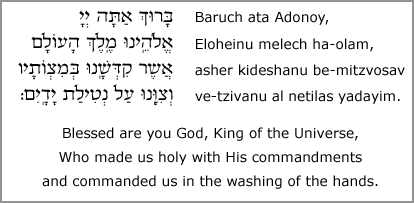 Kabbalistic Tu B’shvat Seder-wash As we raise our hands, we remind ourselves that the food we are about to eat — even though it was made by a human being — ultimately comes from God. As the verse says: He would feed him with the finest wheat (Psalms 81:17). Without speaking from the time of the washing, we then recite the blessing on the bread: 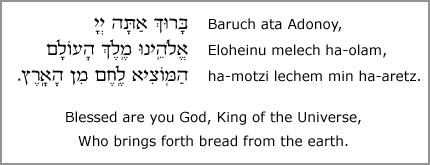 Kabbalistic Tu B’shvat Seder-bread A participant says: The verse says: ‘When you eat the bread of the Land, you shall bring an offering to God’ (Numbers 15:19). This refers to the waving (tenufah) of the Omer. Tenufah can be read as tenu feh — give a mouth. The mouth is symbolic of the honor we give to God. Hence the Omer was waved to show that we give to God this mouth, since the chief praise of God is when the Jewish people give Him honor and glory. Why was the Omer made from barley and not from wheat? Because barley ripens first. Wheat (chita) is the more perfect food, being symbolic of the elimination of sin (chet). There are those who say that wheat is the plant with which Adam sinned. ( Zohar – Balak 189a) Meditation: Savor each bite of the cake or bread. Appreciate that God loves us and created everything for our good. (5) FRUIT On Tu B’Shvat, we eat the fruit by which God Himself praises the Land of Israel. As the verse says: The trees have borne their fruit, fig tree and vine have yielded their strength. Children of Zion be happy, rejoice in the Lord, your God. (Yoel 2:22-23) If you have a preference, eat the fruits in the order you most enjoy. Otherwise the order of eating should be: olives, dates, grapes, figs, pomegranates. Say the following blessing and then eat one of the fruits:
If there is a seasonal fruit at the table which you have not yet tasted this season, say the following additional blessing before eating the fruit:
Take each fruit one by one, as the appropriate paragraph below is recited. Enjoy the many unique flavors and textures. Reflect on the reality that the Creator of time and space wants us to take pleasure in everything that He put into the world. Participants take turns saying the following paragraphs: Olives: God called your name ‘a green olive tree, nice and beautiful fruit.’ (Jeremiah 11:16) Your children shall be like olive plants around your table. (Psalms 123:3) Rabbi Yehoshuah Ben Levi said: Why is Israel compared to an olive tree? Because just as the leaves of an olive tree do not fall off either in summer or winter, so too the Jewish people shall not be cast off — neither in this world nor in the World to Come. (Talmud – Menachot 53b) The Sages taught: Just as olive oil brings light into the world, so do the people of Israel bring light into the world. (Midrash — Shir HaShirim Raba 1:2) Dates: The righteous shall flourish like a palm tree (Psalms 92:13). The righteous are fruitful and sweet, just like a date palm. Your stature is like a palm tree (Song of Songs 7:8). Just as the palm tree doesn’t bend or sway, so too the Jewish people. No part of the palm tree is wasted. The dates are for eating; the Lulav branches are for waving in praise on Sukkot; the dried thatch is for roofing; the fibers are for ropes; the leaves are for sieves; and the trunk is for house beams. So too, every one of the Jewish people is needed. Some are knowledgeable in Bible, others in Mishnah, others in Aggada (homiletic understanding of the Torah). Still others perform many mitzvot, and others give much charity. (Midrash – Bamidbar Raba 3:1) Grapes: Just as a vine has large and small clusters and the large ones hang lower, so too the Jewish people: Whoever labors in Torah and is greater in Torah, seems lower than his fellow [due to his humility]. (Midrash – Vayikra Raba 36:2) Figs: Rabbi Yochanan said: What is the meaning of ‘He who tends a fig tree will eat its fruit’? (Proverbs 27:18) Why is the Torah compared to a fruit tree? Figs on a tree do not ripen all at once, but a little each day. Therefore, the longer one searches in the tree, the more figs he finds. So too with Torah: The more one studies, the more knowledge and wisdom one finds. (Talmud – Eruvin 54a) Pomegranates: Let us get up early to the vineyards. Let us see if the vine has flowered, if the grape blossoms have opened, if the pomegranates have budded. There I will give you my love. If the pomegranates have budded. These are the little children who study Torah and sit in rows in their class like the seeds of a pomegranate. (Midrash – Shir HaShirim Rabba 6:11) For discussion: Rami Bar Yechezkel once came to Bnei Brak and saw goats grazing under a fig tree. Honey was dripping from the figs and milk from the goats — and they became intermingled. He said: Behold, a land flowing with milk and honey! (Talmud – Ketubot 111b) Ask participants to share a story or experience he/she had while in the Land of Israel. (6) WINE: At the Tu B’Shvat seder, it is traditional to drink four cups of wine, similar to the Passover seder.
A participant says: White wine represents nature in potential. Red wine represents nature in full bloom. On this day, we begin to leave the winter behind and move into a period of renewal and life. It is stated in the Zohar: Wine has two colors — white and red. White is from the right side [of kindness]; red from the left side [of strength and judgment]. As we progress from white to red, we move from potential to actuality. We are able to appreciate God’s judgment as well as His kindness. We see God’s design and goodness in the world with increasing clarity. A participant says: Wine rejoices the heart of man. This refers to the wine of Torah. Yayin (Hebrew for wine) equals 70, the numerical value of Sod, meaning secret. [Wine represents the hidden aspects of the Torah.] ( Zohar — Parshat Pinchas). A participant says: The Talmudic section dealing with agriculture is called trust in God. When a farmer plants a seed, trust in God gives him the strength to survive the winter. On Tu B’Shvat he begins to see that trust rewarded. Similarly, when we plant a seed for personal growth, it requires trust and patience to survive the ‘cold,’ before we see the fruits of our labor. We will now drink four cups of wine (or grape juice) in conjunction with four different categories of fruit. Each of these pairs correspond to each of the four spiritual realms (from lowest to highest):
Each level becomes more spiritual and connected to the Creator. As we eat, we elevate the fruits — and ourselves — through the various levels, rising higher and higher. A participant says: The Almighty said: Although wine can be a source of trouble in this world, in the future I shall make it only a source of joy, as it says: ‘And it shall come to pass on that day, that the mountains will drip with sweet wine’ (Yoel 3:18). (Midrash – Vayikra Raba 12:5) Pour the first cup of wine (all white): All say the following blessing, and then drink from the wine (if you haven’t already done so during Kiddush):
Slow down and really enjoy the taste of the wine. The most prestigious universities offer courses in wine tasting. There’s a lot to appreciate in life. Be a connoisseur! The leader says: We now eat fruits with inedible shells or peels. For example: nuts, pomegranate, oranges, avocado. The edible part of the fruit corresponds to perfection and purity, while the inedible is connected to deficiency and impurity. This is parallel to the realm of action (asiah), the lowest of the spiritual worlds — a world which is enveloped by materialism, just as the fruit is enveloped in its peel/shell. A participant says: Rabbi Tarfon compared the Jewish people to a pile of walnuts. If one walnut is removed, each and every nut in the pile is shaken and disturbed. So too, when a single Jew is in distress, every other Jew is shaken. (Midrash – Shir HaShirim Raba 6:11) A participant says: As it is the virtue of a nut to be closed in from all sides, so too the Heavenly Chariot which goes out of the Garden of Eden is hidden on all sides. And just as the four sections of a walnut are united at one side and separated on the other, so are all parts of the Heavenly Chariot united in perfect union — and yet each part fulfills a specific purpose. ( Zohar – Shmot 15b) Meditation: As you toss away the peels and shells, see one of your bad character traits (anger, impatience, etc.) being tossed away. In your mind’s eye, picture the bad trait as the shell. Then, as you toss it away, feel the trait leaving you. That’s not the real you. The real you is the fruit… delicious and nourishing. See the trait going into the garbage. (7) CUPS 2, 3,4 Drink the second cup — pale pink (white with a drop of red). The leader says: We now eat fruits with inedible pits. For example: dates, olives, peaches, plums, cherries. This stage is comparable to the realm of formation (yetzirah). The edible parts of the fruit represent holiness. Pits represent impurities which have penetrated the holiness. As the color of the wine begins to gets darker, we can start to see potential turn into reality. The inedible part has now moved from the outside to the inside of the fruit. This is an advancement toward purity. In addition, the inedible part is no longer waste; it is a seed with potential to grow. Meditation: Imagine one of your bad traits as this seed. Really see it. Then, see that trait growing and developing into something great. This trait no longer holds you back, but propels you forward. Many great people have turned their faults into assets. You too can become great. Drink the third cup of wine (dark pink). The leader says: Now we eat fruits that are completely edible: blueberries. This is the realm of creation (briah), the highest level in the created world. (The three lower worlds — asiyah, yetzirah, and briah — are referred to as ma’aseh bereishit, the act of creation. ) Meditation: Things are coming close to their full potential. Even the seeds are now edible. They not only have future potential, but are also delicious and ready to eat right now. Think about an area of life you would like to improve. Picture your ideal self. Realize that’s the real you. Now, for the rest of Tu B’Shvat, actually be that person. Act as if you’re already there. The experience can be transformational. Drink the fourth cup (red with a drop of white). The leader says: We now taste the fruit on the table with the best fragrance. This is comparable to the realm of pure Godliness (atzilut). This level is called the ma’aseh merkava, the act of the Chariot. The prophet Ezekiel saw a Chariot in his vision relating to the mysteries of creation. A participant says: In Leviticus 23:40, the Esrog is described as pri aitz hadar — fruit of the majestic tree. The Esrog is the most spiritual of all trees, as it’s fruit and bark both have fine taste and smell. On Tu B’Shvat, when all trees are judged, it is fitting to pray for a beautiful Esrog during the coming Sukkot. A participant says: The sense of smell is the purest and most elevated. It is through the nose that God invested Adam with a soul, as it says, God breathed into man’s nostrils a breath of life (Genesis 2:7). Since there is no perceptible physical matter to smell, it is the most spiritual and Godly of the five senses. Burning the fragrant incense was designated as the holiest act of the Jewish year — performed by the Kohen Gadol in the Holy of Holies on Yom Kippur. (8) CONCLUSION The leader says: Eating 12 different fruits is significant, since this corresponds to the 12 different arrangements of the four-letter ineffable Name of God. Upon eating the 12th fruit, we recite the verse: And they shall beat their swords into plowshares, and their spears into pruning hooks. Nation shall not lift up sword against nation, nor shall they learn war any more. But they shall sit each person under his fig tree, and none shall make them afraid, for the mouth of the Lord has spoken (Micah 4:3-4) Eating 15 different fruits is also significant, since this is the numerical value of Yud-Heh, the Name of God which connects the physical to the spiritual, between this world and the next world. In the Holy Temple, the Levites would sing each of the 15 Shir HaMa’alot Psalms as they ascended each of the 15 steps. After-blessing: After enjoying all the wonderful pleasures that God has given us, we complete the process with a meaningful, heartfelt thanks to the Creator. Those who ate bread say the full Grace After Meals. Otherwise, we say the three-faceted blessing — including the relevant lines for cake, wine, and/or fruit, plus the special insertion for Shabbat if applicable. The text of these blessings are found in the ArtScroll Siddur (www.artscroll.com). A participant says: Rabbi Abba taught: There is no more revealed redemption — no greater indication of the impending redemption — than that which the verse (Ezekiel 36:8) states: And you, mountains of Israel, you shall give forth your branches and you shall bear your fruit for my people Israel, for they shall soon come. (Talmud – Sanhedrin 98a) Rashi explains: When the Land of Israel will give fruit bountifully, this is an indication of the impending redemption, and there is no greater indication than this. Conclusion: We come to the end of the Tu B’Shvat seder. We have only touched the surface of the true meaning of the holiday and of the significance of trees and fruit in God’s creation. That is the beauty of the Jewish calendar. Each year we celebrate the same holidays, yet each year we grow and develop many new insights. The rest of the evening is spent singing and learning Torah. Next year in Jerusalem! Published: January 26, 2003
|
|
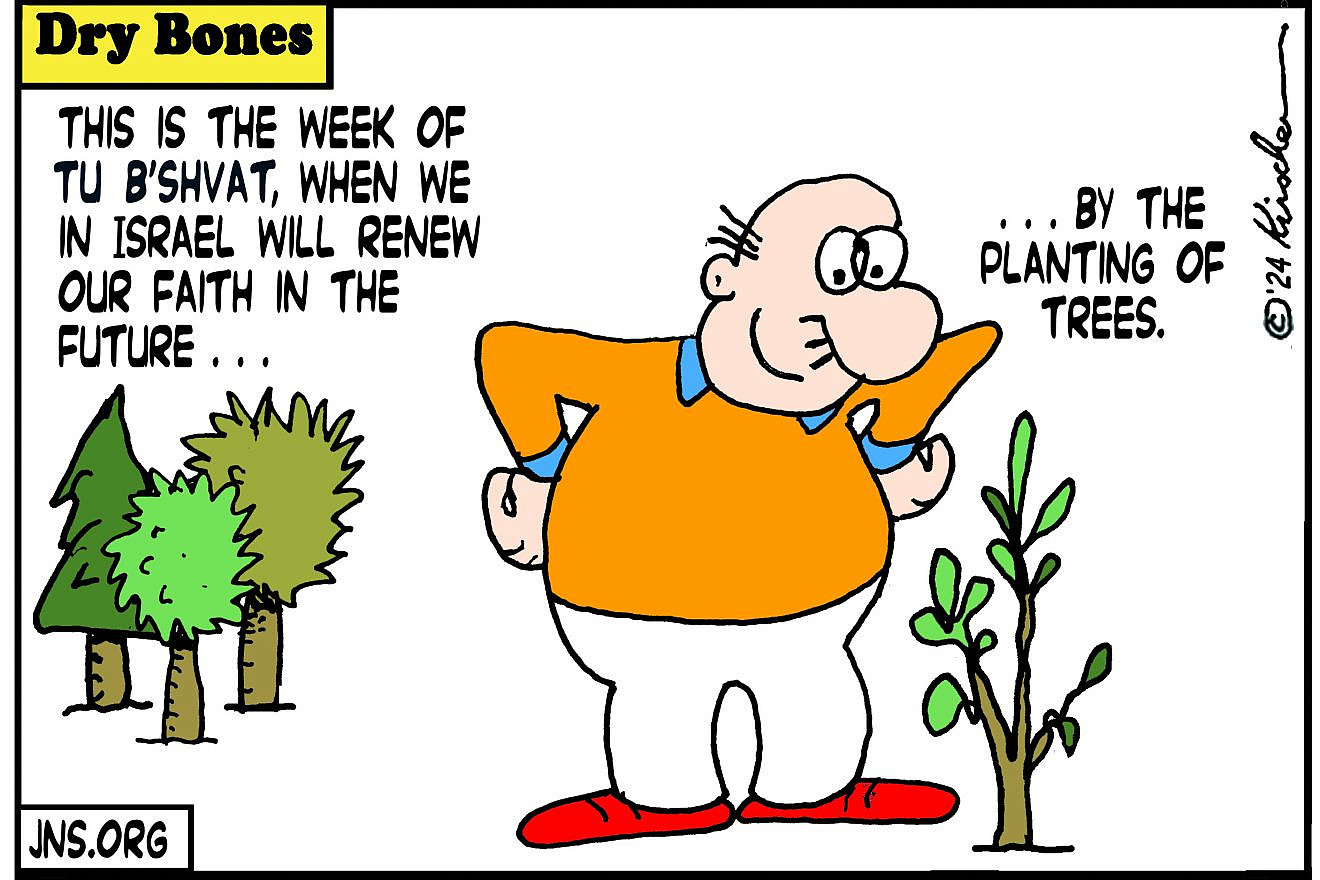 Dry Bones Tu B’Shevat-5784 A Rare Opportunity to Plant Fruit Trees in IsraelMonday, 18 January 2021 https://www.brodyhealth.com/2021/01/hashem-is-so-fantastic-just-yesterday-i-posted-a-full-length-shiur-about-the-importance-of-fulfilling-the-mitzvoth-of-the-l.html Hashem is so fantastic! Just yesterday, I posted a full-length shiur about the importance of fulfilling the mitzvoth of the Land of Israel, especially with Tu B’Shvat a week from Thursday. After the shiur, I had this gnawing feeling at my heart. As a lover of the Land of Israel and a tree-fruit farmer who has planted hundreds, maybe thousands of trees all over Israel, I can’t begin to explain the importance of planting fruit trees in settling our holy homeland. You see, a high-tech professional can work from his desktop or labtop anywhere, but a tree farmer has his hands, heart and entire life here in the Land of Israel. In fact, when you partner with a Torah-observant tree-fruit farmer in Israel, you also partner in the mitzoth of orlah, neta reva’i, trumah, maaser, shemittah and yishuv ha’aretz, settling the Land of Israel. With amazing Divine Providence, my good friends at IsraelTrees.org, a branch of Zo Artzeinu, contacted me this morning and asked if I’d like to offer people the opportunity to plant fruit trees in the Land of Israel. They had to be kidding! Of course! Right now, farmers in Israel begin planting now for the upcoming Shmitta; you can share in this fantastic mitzva and in the blessing that goes along with it. But I made a deal with them – if anyone comes to them from my recommendation, they have to double the plantings. I don’t care how they do it, but they agreed – a deal’s a deal, and everyone’s a winner. Here’s your chance for a really meaningful Tu B’Shvat. When you order the trees, fill in the Promo Code box, “Lazer“, and you’ll get double the trees to your credit. Hashem says, “I will ordain My Blessing for you” (Leviticus 25:21); double the planting, double the Blessing! 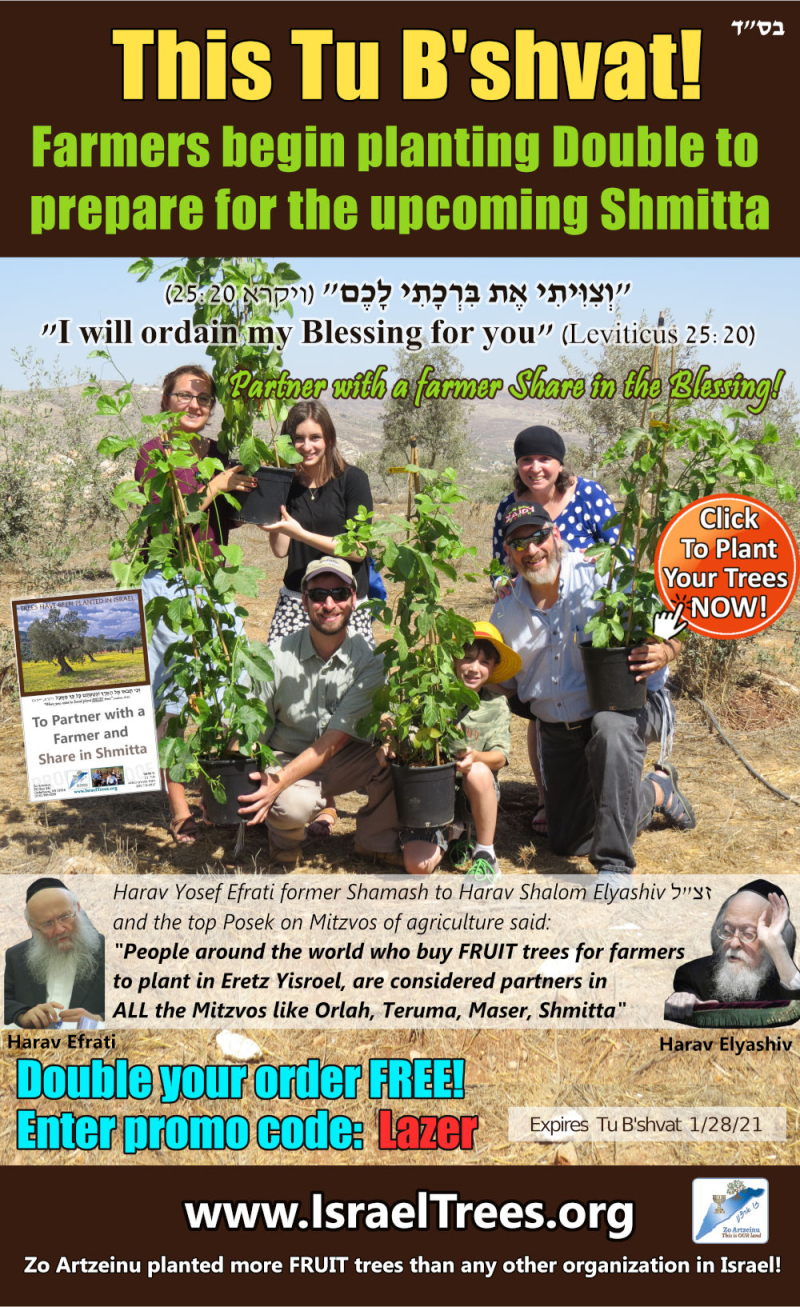 Tu B-shvat-opportunity to plant fruit trees in the Land of Israel.
|